> ## Documentation Index
> Fetch the complete documentation index at: https://magicads.mintlify.site/llms.txt
> Use this file to discover all available pages before exploring further.
# Wasabi Storage
> Offload your Image Studio and Video Studio results to your own Wasabi (S3-compatible) bucket — low, flat pricing with no egress or API-request fees.
This is a **Free** plugin that you can install directly from the in-app **Plugins** marketplace — no purchase required.
## Introduction
**Wasabi Storage** lets you, the platform owner, **offload generated studio results** (Image Studio and Video Studio images and videos) from the local server disk to your own **Wasabi** bucket. Wasabi is an S3-compatible object store known for low, flat pricing with no egress or API-request fees — a cost-effective home for growing media libraries.
Unlike the studios, Wasabi Storage is an **infrastructure** plugin: it doesn't add any user-facing tool. It registers a new storage backend that the platform writes new results to, and serves those results back to users. It plugs into the same shared storage layer as the Amazon S3, Cloudflare R2 and Google Cloud Storage plugins — so exactly **one** backend is active at a time, chosen by you.
Because Wasabi is S3-compatible, it works just like the Amazon S3 plugin. The one Wasabi-specific convenience: the **endpoint is derived from your region automatically** (`https://s3.{region}.wasabisys.com`), so you normally only need your keys, region and bucket.
This guide covers the full lifecycle — how to install it, how to create a bucket and access key, how to configure and test the connection, how to make Wasabi the active storage, and how offloading behaves.
* **Config screen** — an admin page under General Settings → Plugins to enter credentials, tune options and test the connection.
* **Storage provider** — registers **Wasabi** as an option in the platform's **Default Storage** selector.
* **Automatic offload** — when Wasabi is the active storage, every newly finalized studio result is uploaded to your bucket, and the platform records that the file now lives in Wasabi.
* **Transparent serving** — reads, downloads and deletes for offloaded results resolve through Wasabi (or your CDN) automatically.
The plugin only affects **where generated results are stored**. It doesn't change how anything is generated, priced or gated — it's purely a storage backend.
## Installation
Wasabi Storage is a **free** plugin distributed through the in-app plugin marketplace — installation happens inside your MagicAds admin. There's no third-party download and nothing to purchase.
Sign in as an **admin** and go to **Admin → General Settings → Plugins**. Find the **Wasabi Storage** card in the marketplace catalog.
Click **Install** on the **Wasabi Storage** card. The platform downloads the archive, unpacks it, runs its migration and activates the plugin. Its provider details (key, secret, region, bucket, endpoint, URL, path-style, prefix, delete-local) are stored as an **encrypted** settings entry, so adding storage providers never changes the schema.
On a fresh install everything stays on the local disk. Installation only makes the config screen and the storage provider exist. Nothing is offloaded until you **enter valid credentials**, **enable the provider**, and **select Wasabi as the Default Storage** (next sections).
To remove the plugin later, click **Uninstall** on the same card.
## Create a bucket and access key
Before configuring the plugin, set up the bucket and credentials in your Wasabi console.
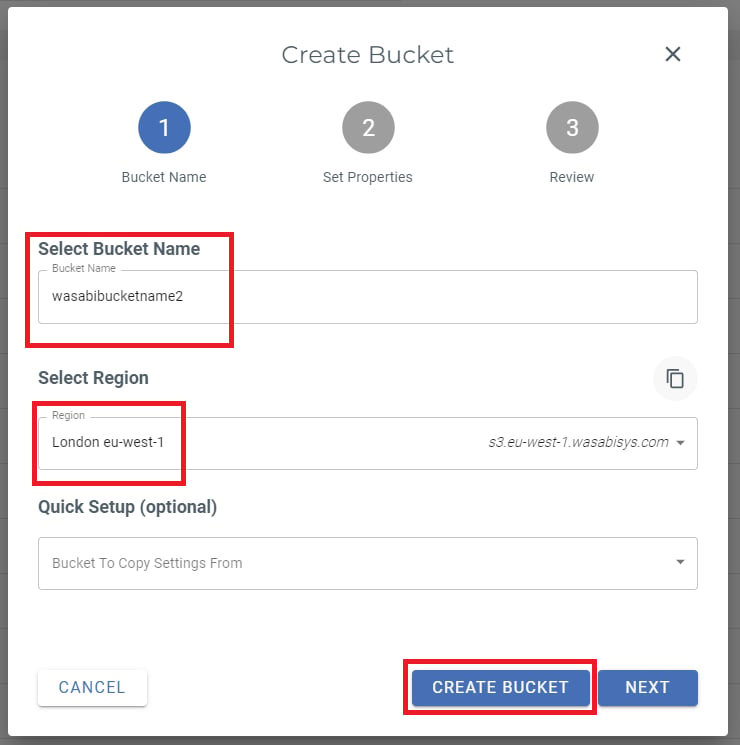
In the [Wasabi console](https://console.wasabisys.com/), open **Buckets** under the Data Access menu and click **Create Bucket**.
 Provide a unique **Bucket Name** and select your **Region** (e.g. `us-east-1`, `eu-central-1`, `ap-northeast-1`), then click **Create Bucket**. Note both — you'll enter them in the plugin config.
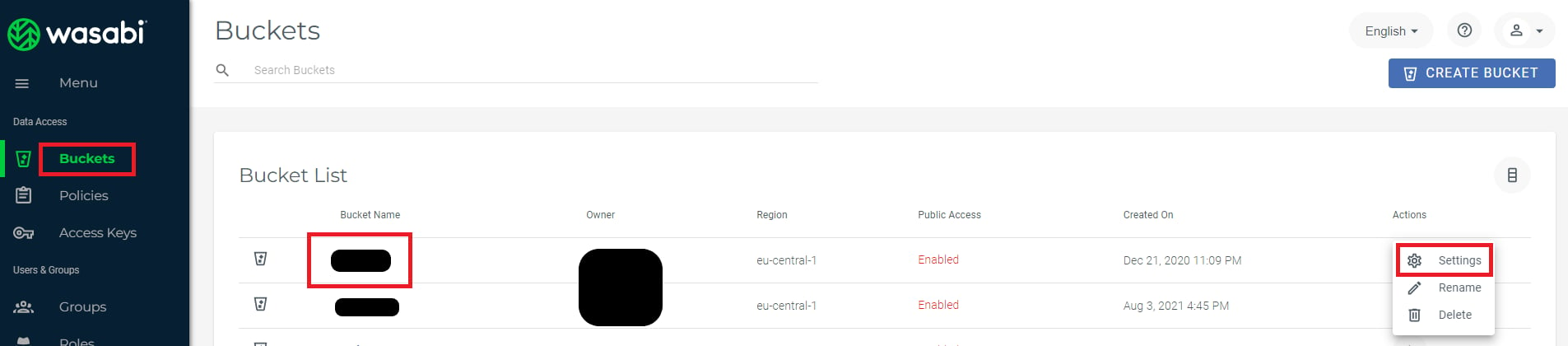
 Select your bucket from the list and, under the **Actions** tab, click **Settings**.
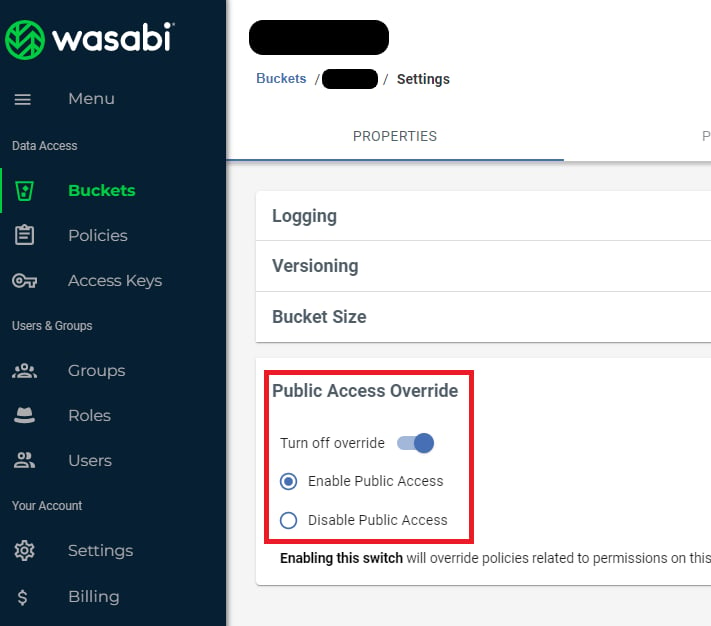
 So generated results are viewable in the app, **Enable Public Access** for the bucket (or serve it through a CDN and set the plugin's **Public / CDN URL** instead).
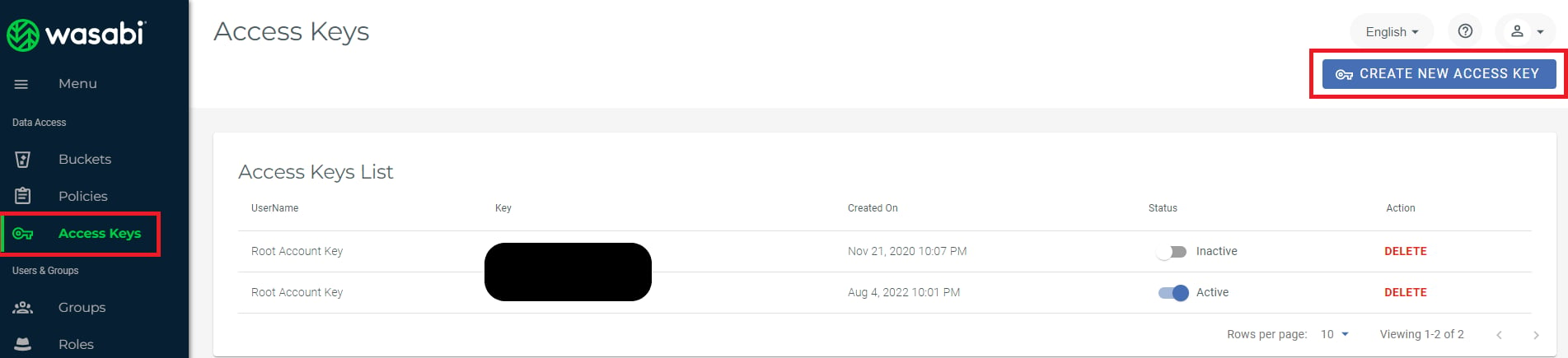
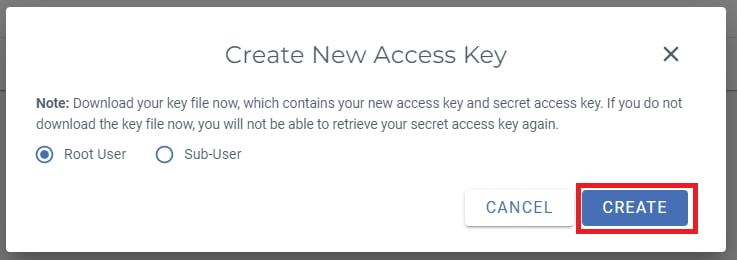
 Go to **Access Keys** under the Data Access menu and click **Create New Access Key**.
 Click **Create**, then **Download** or **Copy** your **Access Key** and **Secret Key** immediately — the secret is shown only once.
 For least-privilege, attach a bucket policy that limits the key to read, write and delete objects in your bucket. The Access Key + Secret Key are S3-style credentials specific to Wasabi, and the secret is stored **encrypted** by the plugin once saved.
## Configure Wasabi
Go to **Admin → General Settings → Plugins → Wasabi Storage** (`/app/admin/general/plugins/wasabi`). The screen has these sections.
### General
| Setting | Purpose |
| ---------------------------------- | ------------------------------------------------------------------------------------------------------------------------------------------------------------------------------ |
| **Enable Wasabi** | Makes Wasabi a selectable option in the **Default Storage** list once credentials are valid. It does **not** by itself route uploads here — you still pick the active backend. |
| **Delete local copy after upload** | When on, the local file is removed once it's safely stored in Wasabi, reclaiming server disk space. Leave off to keep a local backup of every result. |
### Bucket Credentials
| Field | Notes |
| -------------- | ---------------------------------------------------------------------------------------------------- |
| **Access Key** | From your Wasabi console. |
| **Secret Key** | From your Wasabi console. Stored **encrypted**; leave blank on later edits to keep the existing one. |
| **Region** | The bucket's Wasabi region (e.g. `us-east-1`, `eu-central-1`, `ap-northeast-1`). |
| **Bucket** | The Wasabi bucket name. |
### Advanced
| Field | Notes |
| --------------------------- | ------------------------------------------------------------------------------------------------------------------------------- |
| **Custom Endpoint** | Optional. Leave blank to use the region default `https://s3.{region}.wasabisys.com`. Override only for a non-standard endpoint. |
| **Public / CDN URL** | The base URL files are served from — a CDN domain, for example. |
| **Key Prefix** | Optional folder inside the bucket (e.g. `magicads`), transparently prepended to every object key. |
| **Use path-style endpoint** | Off works for standard Wasabi buckets. Enable only if your setup requires path-style addressing. |
To enable the provider you need at minimum the **access key, secret, region and bucket** — the endpoint is filled in for you from the region.
### Connection
Click **Test connection**. The plugin saves your settings, then **uploads, reads back and deletes a tiny probe object** to confirm the bucket is reachable and writable. A green toast means Wasabi is ready; a red toast surfaces the exact error (bad credentials, wrong region/bucket, permissions).
Click **Save** to persist everything.
## Make Wasabi the active storage
Enabling the provider only adds it to the selector. To actually store new results in Wasabi, set it as the platform's **Default Storage**:
Go to **Admin → General Settings → General**.
Set **Default Storage** to **Wasabi**.
Save the change. From that point, every newly finalized studio result is offloaded to Wasabi. Only enabled, fully-configured providers appear in this list, and "Local server (this machine)" is always the fallback.
Only **one** storage backend is active at a time. Selecting Wasabi here makes it authoritative for new results; it does **not** retroactively move files that were already stored locally or on another provider — those keep serving from wherever they already live.
## How offloading works
The platform uses a single shared storage layer, so Wasabi behaves like the other storage plugins:
1. A studio finishes generating an image or video and stores it on the local `results` disk.
2. The platform checks which provider is **active**. If it's Wasabi, the file is streamed up to your bucket under the same relative path it has locally (e.g. `images/gemini/uuid.png`), with your key prefix prepended if set.
3. The creative is marked as living in Wasabi, so future reads, downloads and deletes resolve through Wasabi.
4. If **Delete local copy after upload** is on, the local file is removed to reclaim space.
Two important safety properties:
* **Generation never breaks on storage errors.** If an upload fails, the result simply stays on the local disk and serves from there — the failure is logged, not surfaced to the user.
* **Local is the safe default.** If Wasabi is later disabled, uninstalled, or misconfigured, the platform falls back to local storage for new results, and already-offloaded files keep serving from Wasabi.
Because offloaded objects are served from your bucket's public URL (or the Public / CDN URL when set), features that hand a media URL to a third party (for example, publishing a creative through Social Media Studio) automatically use the Wasabi URL. If the bucket isn't publicly readable and no CDN URL is set, those files won't be reachable.
## Go-live checklist
Admin → General Settings → Plugins → Wasabi Storage → **Install**.
In Wasabi: create the bucket and an access key (with a bucket-scoped policy), and note the region.
Wasabi config → fill in Access Key, Secret Key, Region and Bucket.
Turn on **Enable Wasabi** and **Save**.
Click **Test connection** and confirm the green success toast.
General Settings → General → set **Default Storage** to **Wasabi** → Save.
Generate a new result in Image or Video Studio, then confirm the file appears in your Wasabi bucket and still displays correctly in the app.
Once you trust the setup, optionally turn on **Delete local copy after upload** to reclaim server disk.
Once every step above is green, new studio results are stored in your Wasabi bucket.
## Troubleshooting
| Symptom | Likely cause | Fix |
| -------------------------------------------------------- | --------------------------------------------------------------- | ----------------------------------------------------------------------------------------------- |
| Wasabi doesn't appear in the Default Storage list | Provider not enabled, or credentials incomplete | Enable it and fill in access key, secret, region and bucket. |
| "Connection failed" on test | Wrong keys, region or bucket name | Re-check the access key, the exact region, and the bucket name. |
| "Upload succeeded but the object could not be read back" | Bucket policy too narrow | Grant the key read access to the bucket and retry. |
| New results still stored locally | Wasabi enabled but not selected as Default Storage | Set Default Storage to Wasabi in General Settings → General. |
| Offloaded images show broken in the app | Bucket not public and no CDN URL | Make the bucket/objects publicly readable, or set a Public / CDN URL. |
| Endpoint errors for a non-standard setup | Region doesn't match the bucket, or a custom endpoint is needed | Confirm the region, or set a Custom Endpoint and enable path-style if required. |
| Files served from the wrong path | Key prefix mismatch | Ensure the Key Prefix matches how objects are organized in the bucket. |
| Secret field looks empty when editing | Secrets are never echoed back | Leave it blank to keep the stored secret; type a new value only to replace it. |
| Old files didn't move to Wasabi | Offload only applies to new results | Selecting Wasabi doesn't migrate existing files; they keep serving from their current location. |
The secret key is stored **encrypted** using your app `APP_KEY`. Switching Default Storage back to local (or disabling the plugin) never deletes what's already in your bucket — those files keep serving from Wasabi.
For least-privilege, attach a bucket policy that limits the key to read, write and delete objects in your bucket. The Access Key + Secret Key are S3-style credentials specific to Wasabi, and the secret is stored **encrypted** by the plugin once saved.
## Configure Wasabi
Go to **Admin → General Settings → Plugins → Wasabi Storage** (`/app/admin/general/plugins/wasabi`). The screen has these sections.
### General
| Setting | Purpose |
| ---------------------------------- | ------------------------------------------------------------------------------------------------------------------------------------------------------------------------------ |
| **Enable Wasabi** | Makes Wasabi a selectable option in the **Default Storage** list once credentials are valid. It does **not** by itself route uploads here — you still pick the active backend. |
| **Delete local copy after upload** | When on, the local file is removed once it's safely stored in Wasabi, reclaiming server disk space. Leave off to keep a local backup of every result. |
### Bucket Credentials
| Field | Notes |
| -------------- | ---------------------------------------------------------------------------------------------------- |
| **Access Key** | From your Wasabi console. |
| **Secret Key** | From your Wasabi console. Stored **encrypted**; leave blank on later edits to keep the existing one. |
| **Region** | The bucket's Wasabi region (e.g. `us-east-1`, `eu-central-1`, `ap-northeast-1`). |
| **Bucket** | The Wasabi bucket name. |
### Advanced
| Field | Notes |
| --------------------------- | ------------------------------------------------------------------------------------------------------------------------------- |
| **Custom Endpoint** | Optional. Leave blank to use the region default `https://s3.{region}.wasabisys.com`. Override only for a non-standard endpoint. |
| **Public / CDN URL** | The base URL files are served from — a CDN domain, for example. |
| **Key Prefix** | Optional folder inside the bucket (e.g. `magicads`), transparently prepended to every object key. |
| **Use path-style endpoint** | Off works for standard Wasabi buckets. Enable only if your setup requires path-style addressing. |
To enable the provider you need at minimum the **access key, secret, region and bucket** — the endpoint is filled in for you from the region.
### Connection
Click **Test connection**. The plugin saves your settings, then **uploads, reads back and deletes a tiny probe object** to confirm the bucket is reachable and writable. A green toast means Wasabi is ready; a red toast surfaces the exact error (bad credentials, wrong region/bucket, permissions).
Click **Save** to persist everything.
## Make Wasabi the active storage
Enabling the provider only adds it to the selector. To actually store new results in Wasabi, set it as the platform's **Default Storage**:
Go to **Admin → General Settings → General**.
Set **Default Storage** to **Wasabi**.
Save the change. From that point, every newly finalized studio result is offloaded to Wasabi. Only enabled, fully-configured providers appear in this list, and "Local server (this machine)" is always the fallback.
Only **one** storage backend is active at a time. Selecting Wasabi here makes it authoritative for new results; it does **not** retroactively move files that were already stored locally or on another provider — those keep serving from wherever they already live.
## How offloading works
The platform uses a single shared storage layer, so Wasabi behaves like the other storage plugins:
1. A studio finishes generating an image or video and stores it on the local `results` disk.
2. The platform checks which provider is **active**. If it's Wasabi, the file is streamed up to your bucket under the same relative path it has locally (e.g. `images/gemini/uuid.png`), with your key prefix prepended if set.
3. The creative is marked as living in Wasabi, so future reads, downloads and deletes resolve through Wasabi.
4. If **Delete local copy after upload** is on, the local file is removed to reclaim space.
Two important safety properties:
* **Generation never breaks on storage errors.** If an upload fails, the result simply stays on the local disk and serves from there — the failure is logged, not surfaced to the user.
* **Local is the safe default.** If Wasabi is later disabled, uninstalled, or misconfigured, the platform falls back to local storage for new results, and already-offloaded files keep serving from Wasabi.
Because offloaded objects are served from your bucket's public URL (or the Public / CDN URL when set), features that hand a media URL to a third party (for example, publishing a creative through Social Media Studio) automatically use the Wasabi URL. If the bucket isn't publicly readable and no CDN URL is set, those files won't be reachable.
## Go-live checklist
Admin → General Settings → Plugins → Wasabi Storage → **Install**.
In Wasabi: create the bucket and an access key (with a bucket-scoped policy), and note the region.
Wasabi config → fill in Access Key, Secret Key, Region and Bucket.
Turn on **Enable Wasabi** and **Save**.
Click **Test connection** and confirm the green success toast.
General Settings → General → set **Default Storage** to **Wasabi** → Save.
Generate a new result in Image or Video Studio, then confirm the file appears in your Wasabi bucket and still displays correctly in the app.
Once you trust the setup, optionally turn on **Delete local copy after upload** to reclaim server disk.
Once every step above is green, new studio results are stored in your Wasabi bucket.
## Troubleshooting
| Symptom | Likely cause | Fix |
| -------------------------------------------------------- | --------------------------------------------------------------- | ----------------------------------------------------------------------------------------------- |
| Wasabi doesn't appear in the Default Storage list | Provider not enabled, or credentials incomplete | Enable it and fill in access key, secret, region and bucket. |
| "Connection failed" on test | Wrong keys, region or bucket name | Re-check the access key, the exact region, and the bucket name. |
| "Upload succeeded but the object could not be read back" | Bucket policy too narrow | Grant the key read access to the bucket and retry. |
| New results still stored locally | Wasabi enabled but not selected as Default Storage | Set Default Storage to Wasabi in General Settings → General. |
| Offloaded images show broken in the app | Bucket not public and no CDN URL | Make the bucket/objects publicly readable, or set a Public / CDN URL. |
| Endpoint errors for a non-standard setup | Region doesn't match the bucket, or a custom endpoint is needed | Confirm the region, or set a Custom Endpoint and enable path-style if required. |
| Files served from the wrong path | Key prefix mismatch | Ensure the Key Prefix matches how objects are organized in the bucket. |
| Secret field looks empty when editing | Secrets are never echoed back | Leave it blank to keep the stored secret; type a new value only to replace it. |
| Old files didn't move to Wasabi | Offload only applies to new results | Selecting Wasabi doesn't migrate existing files; they keep serving from their current location. |
The secret key is stored **encrypted** using your app `APP_KEY`. Switching Default Storage back to local (or disabling the plugin) never deletes what's already in your bucket — those files keep serving from Wasabi.